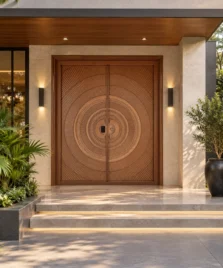
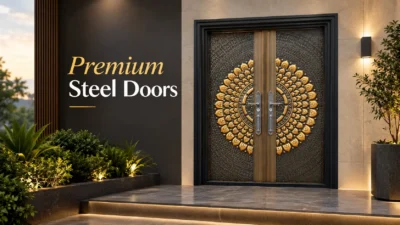
It is July. The monsoons have been endless, and the wooden front door to your house has swelled and is not going to close. Last year it was termites. The year before it was the paint. It happens. It has happened to many other people as well, which is a reason steel doors are gaining popularity in India for residential, commercial, office and institutional use. Here is the issue. Two steel doors may look exactly the same. But they will react very differently to a few monsoons depending on the manufacturer. So, how do we distinguish a top manufacturer from an average one? We’ll look at the differences.
Why Steel Doors in India Are Having a Moment
Indian buyers are getting smarter about long-term value.
- A few things are driving the shift:
- Climate: Humidity, heavy rain and coastal salt air wreck timber over time.
- Security: Steel is much harder to force open than a typical wooden door.
- Low maintenance: No polishing, no termite treatment, no warping.
- Fire safety: Rated steel doors are now standard in many commercial and residential buildings.
Demand has pulled plenty of new players into the market. That’s good for choice, but it also means quality varies a lot. Telling the good from the mediocre is the real skill. [ link – Home Page ]
What Do the Best Steel Door Manufacturers Do Differently?
Experienced steel door manufacturers tend to get seven things right. Use these as your checklist.
1. They Are Obsessive About Raw Material
Everything starts with the steel. Reputable manufacturers use cold-rolled or galvanized sheets of consistent thickness and can tell you the exact gauge. Residential doors typically use around 1.0 to 1.2 mm sheets, while heavy-duty security or industrial doors go thicker. If a seller can’t state the thickness clearly, treat that as a warning sign.
2. They Take Rust Protection Seriously
Steel’s biggest enemy in India is moisture. A door that isn’t properly treated will start rusting from the edges, usually where you can’t see it. Look for a multi-stage process: degreasing, a rust-inhibiting primer or galvanizing, then a baked powder coat. Ask whether the finish has been salt-spray tested. Good manufacturers will have the numbers ready.
3. They Test and Certify, Not Just Claim
A door is only as good as its fit. Laser cutting, CNC bending and robotic or controlled welding produce clean edges, even gaps and doors that close with a satisfying thud rather than a scrape. Cheaper workshops often rely on manual cutting and rough welding. You can usually spot the difference by running your hand along the edges and joints.
4. Their Manufacturing Is Precise
A door is only as good as its fit. Laser cutting, CNC bending and robotic or controlled welding produce clean edges, even gaps and doors that close with a satisfying thud rather than a scrape. Cheaper workshops often rely on manual cutting and rough welding. You can usually spot the difference by running your hand along the edges and joints.
5. They Offer More Than Plain Grey Panels
Gone are the days when steel doors only looked industrial. The best brands offer wood-grain finishes, embossed panels, glass inserts and custom sizes, so the door suits your home instead of fighting it.If you can’t picture a steel door in your living room, ask to see their premium range. You may be surprised.
6. They Stand Behind Installation and After-Sales
A perfect door installed badly is still a bad door. Strong manufacturers either install with trained teams or give clear installation guidance, plus a written warranty that covers rust, finish and hardware. Ask what happens if the door sags after a year. The answer tells you a lot.
7. They Are Transparent About Price
The cheapest quote is rarely the best deal. A trustworthy manufacturer explains why a door costs what it does: sheet thickness, insulation, hardware quality, coating and so on. When one quote is 40% lower than the rest, ask what’s been removed.
How to Vet Steel Door Manufacturers Before You Buy
You don’t need to be an engineer. A few simple steps will filter out most poor options:
- Get requirements in writing. Note the thickness, coating type, core material and hardware.
- Get certificates and reports. Good vendors are happy to supply these.
- Look at a couple of doors which were installed at least two years ago. Either go to a project site or a showroom.
- Get warranties. Check the wording carefully. What is included? What is not?
- Look at reviews and talk to past customers. People in the construction business are great resources.
Have you ever bought something purely on price and regretted it a year later? Doors are one of the worst places to repeat that mistake, because you live with them every single day.
Red Flags to Walk Away From
● No clear answer on steel thickness
● No written warranty
● Prices far below the market with no explanation
● Sample doors that feel hollow, light or flimsy
● No past projects or customer references
Final Thoughts: Choosing the Right Steel Doors in India
The market for steel doors in India is growing fast, and that’s exactly why discernment matters. The best manufacturers earn trust through material quality, proper coating, certified performance, precise build, and honest after-sales support. Marketing alone doesn’t do it. Before you commit, ask for specs, check certificates, see real installations, and read the warranty. Spend an extra week on research now, and you’ll save years of repairs later. Ready to upgrade your entrance? Request a quote or a sample finish from a certified manufacturer, and compare at least three options on thickness, coating, and warranty. Your future self (and your door during the next monsoon) will thank you.
[ Link – product page ]
FAQ
What are the benefits of steel doors in India compared to wooden doors?
Steel doors resist termites, moisture, warping and rot, which are common problems in Indian weather. They also offer stronger security and need very little maintenance, which makes them cost-effective over the long run.
How do I choose the best steel door manufacturers?
Check that they state steel thickness clearly, use a multi-stage anti-rust coating, provide test certificates and offer a written warranty. Visiting a past installation is one of the most reliable ways to judge quality.
How thick should a steel door be for a home?
Most residential steel doors use sheets of roughly 1.0 to 1.2 mm. Security-focused or industrial doors are typically thicker. Confirm the exact gauge with your manufacturer.
Are steel doors in India fire-resistant?
Standard steel doors offer some fire resistance, but only certified fire-rated doors are tested for specific durations. If fire safety is a requirement, look for compliance with IS 3614 and ask for the test certificate.